
Park golf is an outdoor sport that began in Japan in the 1980s and was designed around one simple idea: create a game almost anyone could enjoy. It uses one wooden club, one oversized ball, and a course that can be completed in about two hours. No experience required, which is part of why the sport has taken off in Japan, South Korea, Canada, and increasingly across the United States.
This guide covers where park golf came from, how it is played, how it sits alongside regular golf and mini golf, and why it is finding a following in New Jersey.
What is park golf?
So what exactly is park golf? It’s basically golf, simplified, a community-friendly version played on a small, natural grass course instead of the sprawling, hundred-acre layouts you picture with regular golf. Park golf courses are compact by design, often tucked into public parks, greenways, or local rec areas.
The whole game is stripped down to the basics:
One club — no lugging around a bag full of irons and woods. Every player just uses a single, specialized wooden club.
One ball — solid plastic, about the size of a billiard ball, and brightly colored so it’s easy to keep track of.
9 or 18 holes — courses follow standard layouts, with holes running anywhere from 30 to 100 yards.
What really makes the sport click, though, is how accessible and easygoing it is. Because the distances are shorter and the ball is easier to launch, the game moves quickly. It completely eliminates the slow, frustrating bottlenecks often found in other sports. It is built for all ages, meaning a seven-year-old child, a parent, and a grandparent can comfortably share the exact same scorecard without anyone feeling left behind or outmatched.

The history of park golf
To truly understand the sport, you have to look back to the town of Makubetsu, located in the Hokkaido prefecture of northern Japan. In 1983, a group of local community organizers led by a man named Toyojiro Maeda realized that their town needed a new kind of community activity.
Japan was facing a unique demographic shift. The country’s population was aging rapidly, and local leaders wanted a form of accessible recreation that would keep older residents physically active, mentally sharp, and socially connected. Traditional sports were either too physically punishing or too expensive, while community centers kept people indoors.
Maeda and his team looked at the wide-open green parklands along the Saru River and had an epiphany. They decided to combine the physical movement of a stroll in the park with the rules of golf. The first course was crude, carved right into the public park grass, but the response was immediate.
What started as a local project for seniors exploded in popularity across all generations. By the late 1980s, the Japan Park Golf Association was formed to standardize rules and equipment. The sport quickly spread from Hokkaido to every corner of Japan.
From there, it became an international phenomenon. South Korea embraced the game next, building massive riverside courses. Soon, Canadian communities, European towns, and venues across the United States began recognizing the value of a sport that brings people together outside without a steep barrier to entry.
Why was park golf invented?
This deserves its own section because the core philosophy shapes how the game is played today. Park golf was not created to be a high-stakes competitive sport. It was invented to remove the heavy barriers that keep ordinary people away from outdoor recreation.
Traditional golf naturally comes with a few logistical hurdles. You have to buy or rent a full set of clubs, keep track of a bag full of gear, navigate strict dress codes, and book expensive tee times. On top of that, learning how to swing ten different clubs properly takes a lot of time and practice, which can be a bit overwhelming if you are just looking for a casual weekend outing.
The founders of park golf wanted an affordable option that a family could decide to play on a whim. By reducing the equipment to just one club and simple rules, they leveled the playing field. Grandparents could invite their grandkids out for an afternoon, teach them the game in sixty seconds, and enjoy genuine quality time together in nature. The philosophy is entirely focused on inclusion, health, and community wellbeing.
How do you play park golf?
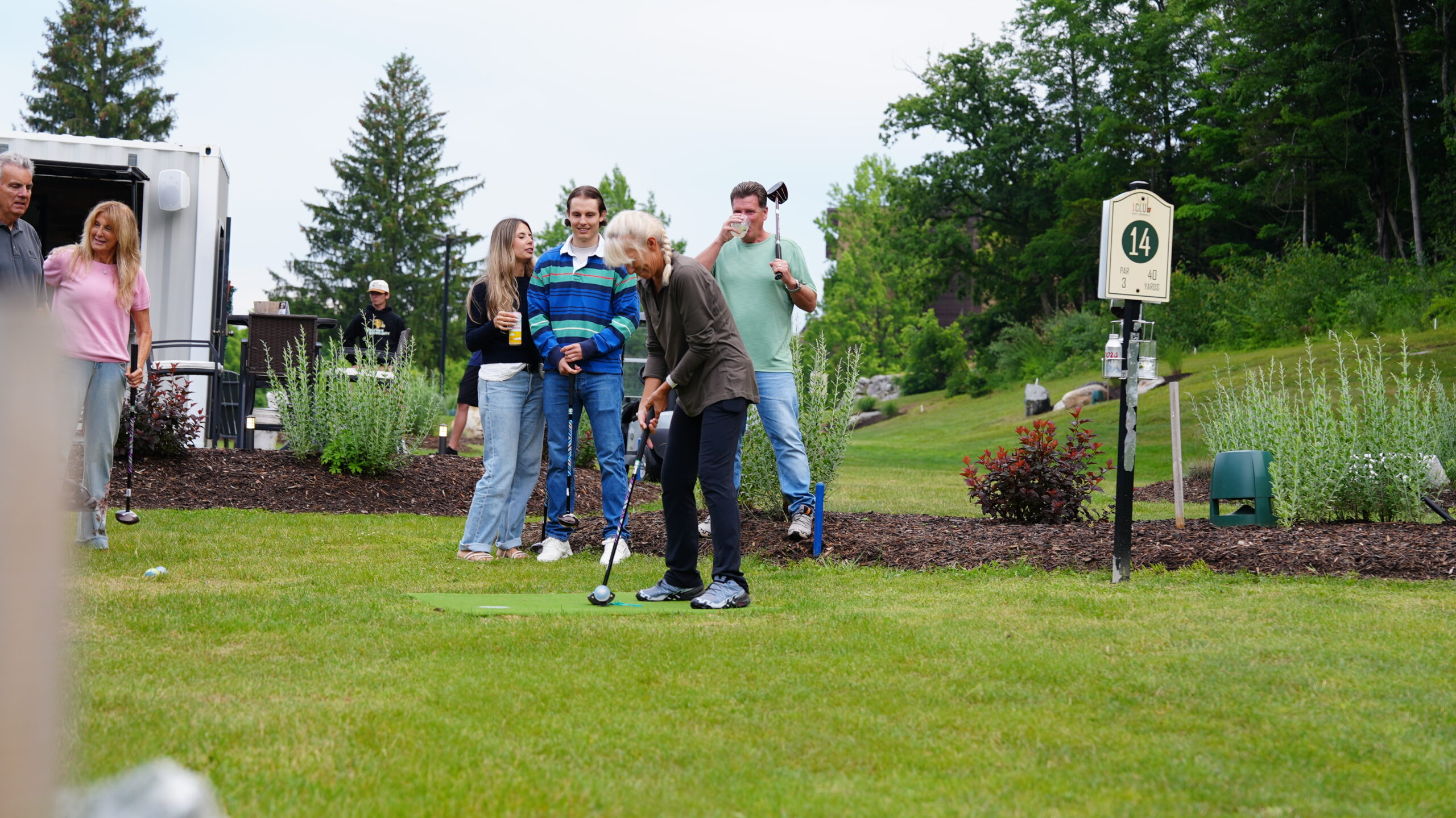
Playing a round is incredibly intuitive. You move through each hole using a natural progression that anyone can pick up after watching a single example.
- The tee shot: You place your oversized ball on a small rubber tee at the start of the hole. Using your single wooden club, you take a smooth, full swing to launch the ball down the fairway.
- The fairway: From there, you play the ball wherever it lands. Since you’ve only got that single club, it’s all about adjusting your swing power: a low rolling shot here, a short chip over the grass there, depending on how far you are from the pin.
- Putting: Once you reach the green, that same club doubles as your putter. You just gently stroke the ball toward the cup. And because the holes are noticeably bigger than on a traditional course, sinking the putt feels satisfying instead of nerve-wracking.
- Scoring: You count every stroke it takes to get the ball into the cup. The player with the lowest total score at the end of the 9 or 18 holes is the winner.
If you want a deeper look at the specific details before you head out, you can check out the 1Club About the Sport page for a complete breakdown.
Park golf rules explained
The rulebook is refreshingly brief. The goal is to keep the game moving and ensure everyone has a safe, relaxed time.
- One club, one ball: You must use the same approved club and ball throughout your entire round.
- Stroke play: Every swing counts as a point. Missing the ball completely (a whiff) does not count as a stroke, which keeps things friendly for absolute beginners.
- Out of bounds (OB): If your ball lands outside the designated boundary markers or in an unplayable area, you take a two-stroke penalty, place the ball back in bounds near where it exited, and keep playing.
- Order of play: The person furthest from the hole always hits first to keep the group safely behind the line of fire.
- Etiquette and pace: Players are expected to replace any displaced turf (divots) and move along at a steady walk so groups behind them can enjoy their day too.

Park golf vs traditional golf
It is common to compare the two, but they simply serve different purposes. One is a lifetime sport built on technical mastery and vast landscapes, while the other is an accessible recreation built on simplicity and social connection.
Park golf vs mini golf
People often mistake park golf for mini golf, but they are completely different experiences once you step onto the course.
Mini golf is fundamentally an amusement attraction. It relies on artificial obstacles like windmills, concrete borders, and themed statues. You only use a putter, and you never hit the ball more than a few feet at a time. Mini golf is pure entertainment.
Park golf, on the other hand, is true outdoor recreation. It features actual grass fairways, roughs, sand traps, and natural terrain. You get to take real, full-body swings, watch your ball roll over natural contours, and navigate actual outdoor landscapes. It gives you the physical satisfaction of playing a sport while keeping things incredibly relaxed.
Why park golf is growing worldwide
Data from organizations like the International Park Golf Association and the Japan Park Golf Association shows that the sport is experiencing a major global surge. Today, there are thousands of courses operating worldwide, generating millions of rounds played annually.
A big driver of this growth is the shifting focus toward outdoor wellness and family recreation. The Outdoor Industry Association has consistently noted in recent reports that modern consumers are looking for outdoor activities that do not require specialized training or intense gear. People want a quick escape into green spaces. Park golf fits this demand perfectly, giving communities a low-impact way to keep citizens active, healthy, and connected.
Why people love park golf
The massive appeal comes down to a few undeniable emotional and social benefits:
- Anyone can play: There is absolutely zero intimidation. You do not have to worry about looking foolish or holding up a line of serious golfers.
- It gets people outside: The American Psychological Association has shown that spending just a couple of hours in a natural environment significantly lowers stress, sharpens focus, and boosts overall mood.
- It encourages conversation: Because the course layout is compact, your group walks together from hole to hole. You are close enough to chat, laugh, share stories, and actually look at each other instead of staring at a smartphone screen.
- It is active without being exhausting: You get the benefits of steady walking and light movement without waking up sore the next day.
Park golf in New Jersey
The sport has officially arrived in the Garden State thanks to 1Club, which holds the unique title of being the first and only place to play park golf in New Jersey.
It is a perfect fit for the state. New Jersey actually has the highest population density of any state in the U.S., which means our public parks, county reservations, and rail trails are constantly buzzing with people. Finding a wide-open outdoor space where you can actually get away from the crowds, relax with friends, and try something new without waiting in long lines is increasingly tough to find here.
Recognizing that people in the tri-state area are constantly hunting for fresh outdoor activities that do not require a massive road trip or a steep learning curve, 1Club brought this Japanese tradition straight to Vernon. It bridges the gap between a classic afternoon out in nature and a modern social gathering. Because it is completely unique to this corner of the state, it gives locals and weekenders from the city a recreational experience they literally cannot find anywhere else in New Jersey.
Experience park golf at 1Club
Located at the historic Great Gorge property in Vernon, the 1Club New Jersey location blends the sport perfectly with the surrounding highlands. The course naturally follows the existing scenic views, mature trees, and rolling terrain, meaning you get to experience the game exactly how its founders intended.
At 1Club, the day does not end when you sink your final putt on the 18th hole. Carefully selected music plays softly across the course to keep the energy upbeat while you play. Once you finish your round, you can head over to Hef’s Hideaway for handcrafted cocktails and refreshing mocktails. If you are hungry, Hef’s Hut is steps away, serving elevated comfort food like house-smoked wings, crispy chicken bao, and baby back ribs on a patio with beautiful ridge views.
Ready to play? You can head straight to the 1Club calendar to book your park golf experience and secure your tee time for the upcoming weekend.
Is park golf good exercise?
The CDC considers steady walking and light movement to be excellent low-impact exercise, and a round of park golf checks that box nicely. You’re on your feet and moving for roughly two hours, which is great for your heart and muscles without putting stress on your joints. Add in the fresh air and green scenery, and you’ve got a workout that doesn’t feel like a workout, just a genuinely good way to clear your head.
Frequently asked questions
What is park golf?
Park golf is a beginner-friendly outdoor sport played with a single wooden club and an oversized ball. The goal is simple: get the ball into each hole in as few strokes as possible, on a compact, natural grass course.
Who invented park golf?
A community organizer and recreation planner named Toyojiro Maeda, along with a small group of collaborators, developed the sport in Japan in the early 1980s with the specific goal of creating something accessible to all ages.
Where did park golf start?
Makubetsu, a town in Japan’s Hokkaido prefecture, in 1983.
Can kids play?
Easily. The clubs are lightweight and the ball is forgiving enough that kids can keep up with adults from the first hole rather than spending the round getting frustrated. It is genuinely one of the better formats for mixed-age groups.
How long does a round take?
An 18-hole round runs about two hours for most groups, give or take depending on how many people you are playing with and how much time everyone spends debating their shot selection.
Is park golf hard?
No. The game has a very short learning curve. Most first-time players understand how to hit the ball and follow the rules within the first five minutes of stepping onto the course.
Do I need golf experience?
Not at all. Park golf was specifically designed so that people who have never picked up a traditional golf club can play competitively right away.
Can seniors play?
Yes. It was originally created in Japan to help aging populations stay active. The shorter walking distances and low-impact swinging motion make it excellent for older adults.
How much walking is involved?
You will be walking continuously for about two hours, but the fairways are much shorter than traditional golf courses, so it feels more like a casual stroll through a park.
How many clubs do you use?
You use exactly one club for the entire game. The single wooden club is designed to handle tee shots, fairway lies, and putting.
Is park golf the same as mini golf?
Not even close. Mini golf is putters-only on artificial turf, with windmills and obstacles doing most of the work. Park golf is played on real grass with actual fairways, rough, and sand traps. You take full swings, manage distance, and deal with the same variables a real course throws at you, just with one club and a more forgiving format.
Where can I play park golf in New Jersey?
At 1Club, located on the Great Gorge property in Vernon, NJ.
Conclusion
Park golf succeeds because it does not ask people to become master athletes. It simply gives them a reason to spend a couple of hours outdoors together. In a world where free time often feels rushed and overscheduled, there is something deeply refreshing about a game designed entirely around conversation, steady movement, and enjoying the company of the people you are with.
Whether you are discovering the sport for the first time or planning your first visit to 1Club, chances are you will understand its appeal long before you reach the final hole.